Save £10 or £25 off your first weight loss consultation with code FIRSTWL10 or FIRSTWL25





Saturday 11 July
Quviviq vs Zopiclone: Which Is Better for Insomnia?
Reviewed by: Irfan Mahmud, Superintendent Pharmacist - GPhC Registration: 2080386 │ GPhC Pharmacy: 9012581
Last clinically reviewed: 27.06.2026
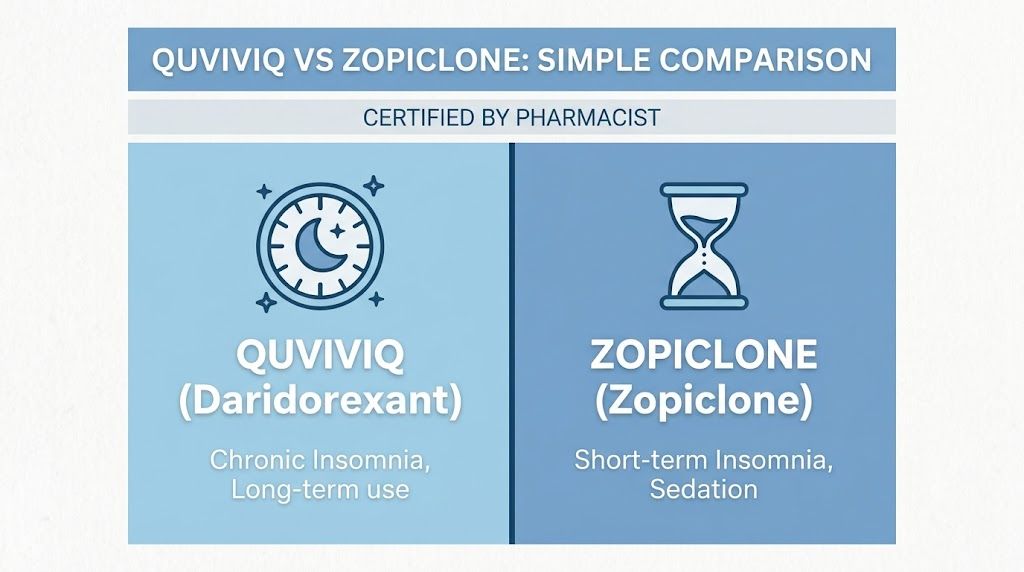
If you have been prescribed zopiclone in the past and are now hearing about Quviviq (daridorexant), you may be wondering how they compare, and which is the better option for your sleep. The honest answer is that they are not really competing for the same job. They are two different kinds of medicine, designed for two different situations.
Zopiclone is a short-term sedative. Quviviq is a longer-term treatment that works in an entirely different way. This guide explains how each one works, what they are licensed for, how they differ on the things that matter most, dependence, next-day grogginess and long-term use, and how to think about which is right for you. As with all insomnia treatment, the recommended first step in the UK is cognitive behavioural therapy for insomnia (CBTi), not medication.
| Quviviq (daridorexant) | Zopiclone | |
| Drug class | Dual orexin receptor antagonist (DORA) | Z-drug (non-benzodiazepine hypnotic) |
| How it works | Blocks the brain's "wake" signal (orexin) | Sedates the brain via the GABA system |
| Licensed use | Chronic (long-term) insomnia | Short-term insomnia |
| Typical duration | Reviewed at 3 months; up to ~12 months | Usually no more than 2–4 weeks |
| Dependence / tolerance | None shown in studies; no rebound | Risk of dependence and tolerance |
| Next-day grogginess | Less | More common |
| Sleep pattern | Largely preserved | Can be altered |
| UK legal status | Prescription-only medicine (POM) | Controlled drug (Class C) |
| Doses | 25 mg, 50 mg | 3.75 mg, 7.5 mg |
Let's take a closer look at how these differences affect your treatment and daily routine.
How they work
This is the most important difference, because it explains almost everything else.
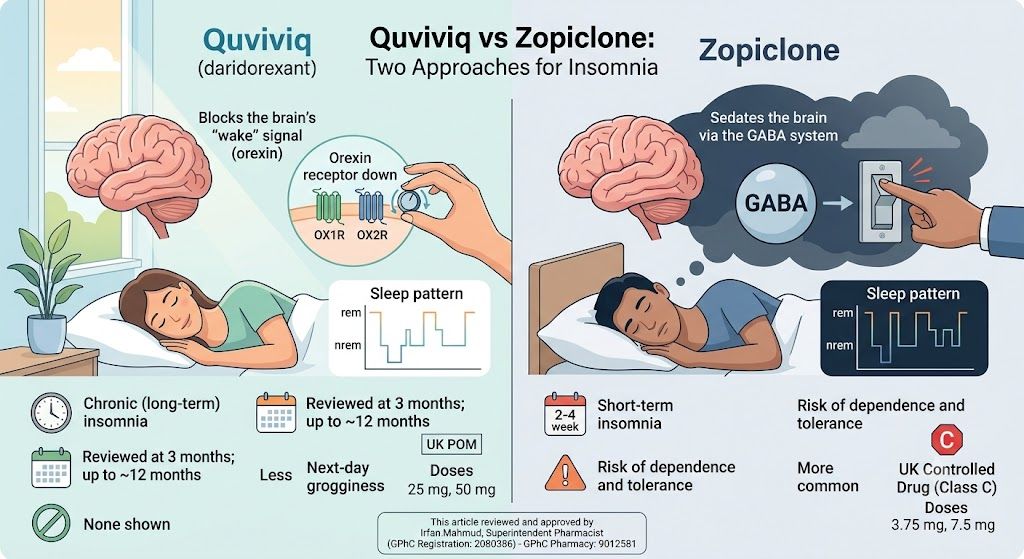
Zopiclone belongs to a group of medicines called "Z-drugs." It works on the brain's GABA system, the same broad mechanism as benzodiazepines (such as diazepam). GABA is the body's main calming signal, and zopiclone amplifies it, dampening overall brain activity to make you feel sleepy. In effect, it sedates you. It works quickly, usually within about an hour, which is why it is effective at getting people off to sleep in the short term.
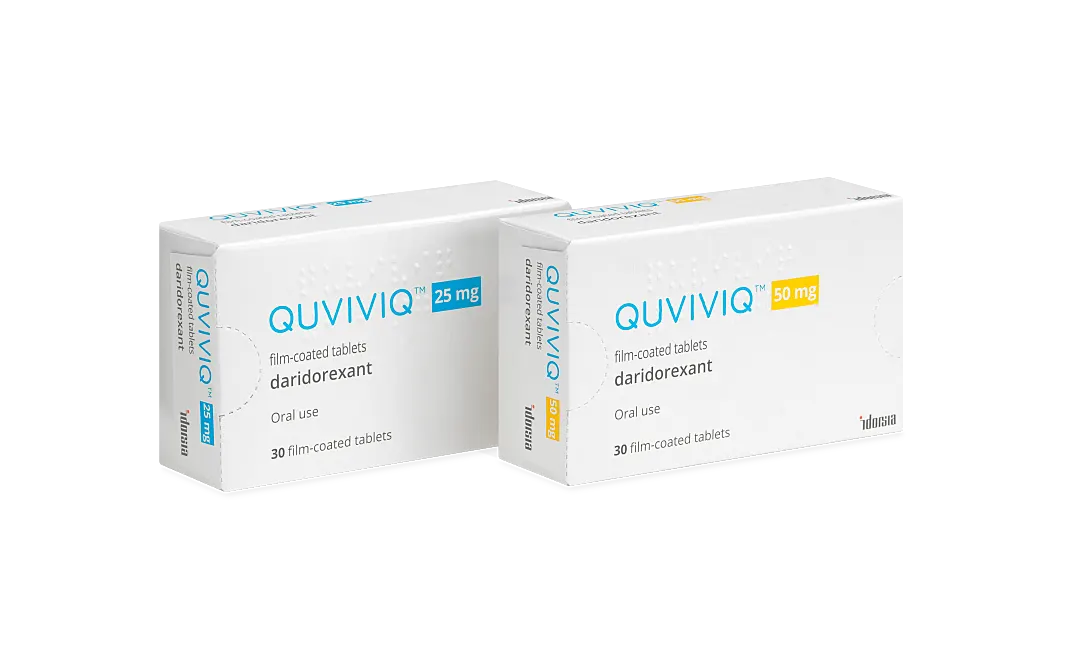
Quviviq (daridorexant) works the opposite way round. Instead of adding a sedative signal, it removes a wakefulness one. Your brain has an "alertness" system driven by a chemical called orexin, which acts on two receptors (OX1R and OX2R) to keep you awake. In many people with insomnia, this system is overactive at night. Daridorexant is a dual orexin receptor antagonist, it blocks both receptors, turning down the excessive wake drive so your natural sleep can take over.
A simple way to picture it: zopiclone is a sedative that switches the whole brain down; Quviviq is a precision switch that quietens only the part keeping you awake. Because Quviviq doesn't broadly sedate the brain, it tends to preserve natural sleep architecture and cause less next-morning grogginess.
What each one is licensed for
The two medicines are licensed, and intended, for different timeframes, and this is where people most often get confused.
Zopiclone is for short-term use. UK guidance recommends it for short courses, usually no longer than two to four weeks (including the period of coming off it). This is because the body can develop tolerance (the medicine works less well over time) and dependence with longer use. Zopiclone is best thought of as a short-term tool to break a difficult patch of poor sleep, for example, during an acute stressful period, not as an ongoing solution.
Quviviq is for chronic insomnia. It is licensed specifically for adults whose insomnia has lasted at least three months and is significantly affecting their daytime functioning. It is designed to be used over a longer period: treatment is reviewed at 3 months, and where it is helping it can be continued with regular review, up to around 12 months in total. In the UK, NICE recommends it for people whose chronic insomnia has not responded to CBTi, or for whom CBTi is unsuitable or unavailable.
So the question which is better? Partly answers itself depending on your situation: a short, acute bout of sleeplessness is a different problem from insomnia that has dragged on for months.
How effective are they?
Both medicines improve sleep, that is not in dispute. The difference is in how the effect is achieved and how it holds up over time.
Zopiclone is effective at helping people fall asleep in the short term, which is exactly what it is designed for. Its limitation is durability: because of tolerance and dependence risk, it is not intended to keep working night after night for months.
Quviviq has been studied for sustained use. In two large Phase 3 trials (published in The Lancet Neurology, 2022), daridorexant 50 mg helped people fall asleep faster and stay asleep longer than placebo, and, importantly, improved how people functioned the next day, measured over up to 12 months. That daytime benefit is a meaningful point of difference: many sedatives improve night-time sleep but leave people feeling dull the following day.
Neither is a magic cure, and individual results vary. But for ongoing insomnia, a medicine designed and tested for longer-term use has a clear logic that a short-term sedative does not.
Sources: Mignot E et al., Lancet Neurology, 2022; QUVIVIQ SmPC (MHRA); NICE TA922; BNF/NICE guidance on zopiclone.
Dependence, tolerance and rebound — the key difference
For many people researching this comparison, this is the deciding factor.
Zopiclone carries a recognised risk of dependence and tolerance, which is the main reason it is restricted to short-term use. Stopping it, especially after prolonged use, can cause rebound insomnia, where sleep temporarily becomes worse than before, and sometimes withdrawal effects. Coming off zopiclone after extended use may need to be done gradually.
Quviviq has a markedly different profile. In clinical studies, there was no evidence of physical dependence, withdrawal symptoms on stopping, or rebound insomnia, and no tolerance has been found to date. In practical terms, this means it can usually be stopped without gradually tapering the dose. This lower dependence risk is the central reason Quviviq can be used for chronic insomnia where zopiclone cannot.
This does not make zopiclone a "bad" medicine, used briefly and appropriately, it is a useful and effective short-term option. But if you need help with sleep over a longer period, the dependence profile is a genuine and important advantage of Quviviq.
Next-day effects and driving
A common complaint with sedative sleeping tablets is the "hangover" feeling, grogginess, slowed reactions or poor concentration the next morning.
Zopiclone can cause next-day drowsiness and impaired alertness, particularly at higher doses or in older adults, and this can affect activities such as driving. In a dedicated driving study, daridorexant 50 mg showed less next-morning driving impairment than zopiclone, a relevant, concrete difference if you need to be alert and safe the following day.
That said, Quviviq is not free of next-day effects: you should not drive or use machinery for at least 9 hours after taking it, especially during the first 5 days of treatment, and only take it when you can allow at least 7 hours for sleep.
Side effects
Both medicines are generally tolerated, but their side-effect profiles differ.
Zopiclone commonly causes a distinctive bitter or metallic taste in the mouth (a hallmark of the medicine), along with drowsiness, dry mouth and sometimes next-day grogginess.
Quviviq's most common side effects (around 1 in 10 people) are headache, excessive sleepiness, dizziness, tiredness and nausea, which often ease as the body adjusts. Less commonly (around 1 in 100), it can cause sleep paralysis or hallucinations when falling asleep or waking.
With both medicines, avoid alcohol, and tell your prescriber about all other medicines you take. Report any suspected side effects via the MHRA Yellow Card scheme.
Report side effects: yellowcard.mhra.gov.uk
Controlled drug status
This is a practical and often-overlooked difference.
Zopiclone is a controlled drug in the UK (Class C), reflecting its dependence and misuse potential, which brings additional prescribing controls.
Quviviq is a prescription-only medicine (POM) in the UK, it is not scheduled as a controlled drug. (In the United States it is classified as a Schedule IV controlled substance, but its UK legal status is POM.) It still requires a prescription and a clinical assessment.
Which is right for you?
There is no single winner, the better choice depends on your situation. A few principles help:
- CBTi comes first. For chronic insomnia, cognitive behavioural therapy for insomnia is the recommended first-line treatment. Medication is considered when CBTi has not worked or isn't available.
- A short, acute bout of poor sleep (for example, a stressful few weeks) is the situation zopiclone was designed for, a brief course to get you through it.
- Insomnia that has lasted months and affects your days is the situation Quviviq was designed for, a longer-term treatment with a lower dependence risk.
- If you are wary of dependence, or have struggled to come off sleeping tablets before, the difference in dependence profile is a significant point in Quviviq's favour for ongoing use.
- If next-day alertness matters (for work or driving), the lower next-morning impairment seen with Quviviq is worth weighing.
Ultimately, this is a decision to make with a prescriber who knows your history. Our clinical team can assess whether Quviviq is a safe and suitable option for you.
Find out if Quviviq is right for you Learn more on our Quviviq (daridorexant) treatment page, or complete a confidential online assessment reviewed by our clinical team.
Cost and availability
Zopiclone is an inexpensive generic medicine and is widely available on the NHS for short-term use. Quviviq on private prescription available on our site, following an online consultation (with NHS access via the NICE pathway for eligible patients whose insomnia has not responded to CBTi). Because they are used so differently, a short course versus longer-term treatment, comparing them on price alone is misleading. The more useful comparison is which one fits your clinical situation.
Frequently asked questions
Is Quviviq better than zopiclone?
Neither is universally "better", they are designed for different situations. Zopiclone is a short-term sedative; Quviviq is a longer-term treatment with a lower dependence risk and less next-day grogginess. For chronic insomnia, Quviviq has clear advantages, for a brief acute episode, a short course of zopiclone may be appropriate.
Can I switch from zopiclone to Quviviq?
This may be possible if you have ongoing insomnia and want to move away from a short-term sedative, but it should be done under clinical guidance, your prescriber will assess your history and how to make the change safely.
Is Quviviq less addictive than zopiclone?
Studies of Quviviq found no evidence of dependence, withdrawal or rebound insomnia, whereas zopiclone carries a recognised dependence risk and is restricted to short-term use. Quviviq can usually be stopped without tapering.
Will Quviviq leave me groggy like zopiclone?
Quviviq tends to cause less next-morning grogginess, and showed less driving impairment than zopiclone in a dedicated study. However, you should still avoid driving for at least 9 hours after a dose, especially in the first few days.
Is zopiclone a controlled drug?
Yes, zopiclone is a Class C controlled drug in the UK. Quviviq is a prescription-only medicine and is not scheduled as a controlled drug.
The verdict: Quviviq or zopiclone?
Quviviq and zopiclone both help with sleep, but they are built for different jobs. Zopiclone is a fast-acting, short-term sedative, useful for a brief patch of poor sleep, but limited by dependence and tolerance. Quviviq works in a different way altogether, quietening the brain's wakefulness signal rather than sedating it, which allows it to be used for chronic insomnia with a lower risk of dependence and less next-day grogginess.
If your insomnia has lasted months and is affecting your days, Quviviq is the option designed for you, ideally alongside good sleep habits, and after CBTi where possible. A short online consultation can establish whether it is safe and suitable in your case.
This article has been reviewed and approved by Irfan Mahmud, Superintendent Pharmacist (GPhC Registration: 2080386). Dispensed by our GPhC-registered pharmacy (Registration: 9012581), regulated by the General Pharmaceutical Council.
This content is for informational purposes only and does not constitute medical advice. Quviviq and zopiclone are prescription-only medicines. Always read the patient information leaflet and consult a qualified healthcare professional before starting, stopping or changing any medication. Report suspected side effects via the MHRA Yellow Card scheme: yellowcard.mhra.gov.uk.
Last clinically reviewed: 11.07.2026.